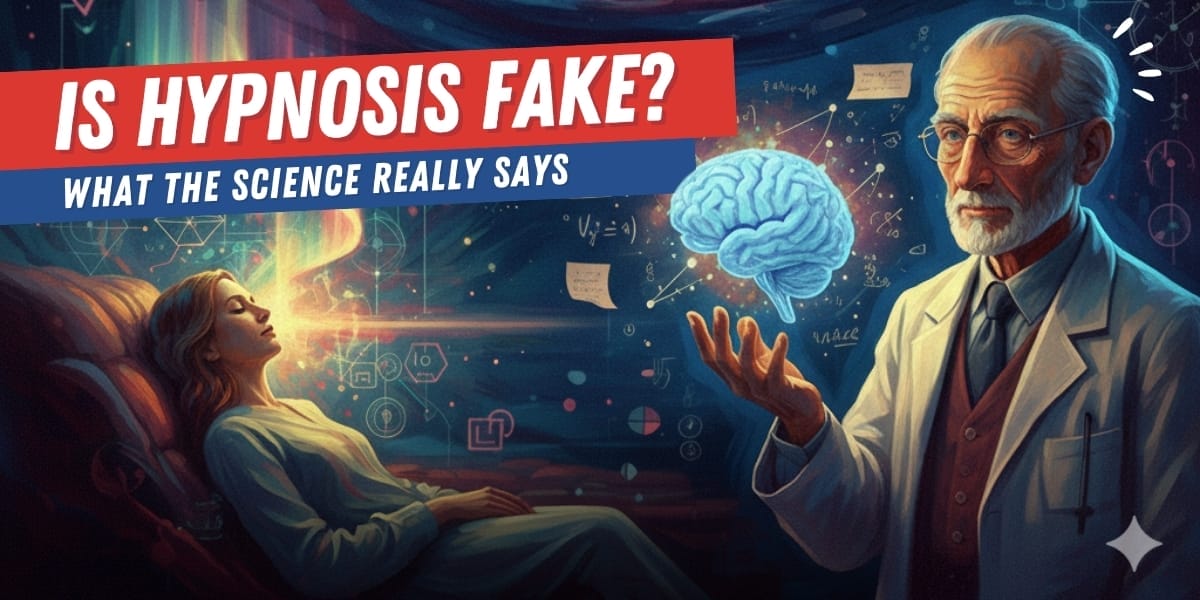
Hypnosis gets called “BS” all the time. Scroll through social media, glance at a comment section under a hypnosis video, or watch a stage show clip, and it will not take long before someone confidently declares that it is fake, staged, or only works on weak-minded people.
Here is the strange part. Hypnosis keeps working anyway.
It works in medical settings, therapy, performance, and everyday life, whether people realize it or not. So how did hypnosis earn such a stubborn reputation as modern snake oil, and why does that belief persist despite decades of evidence to the contrary?
Let’s clear the fog.
Why Hypnosis Is Often Dismissed As Fake
Most skepticism about hypnosis does not come from careful study or firsthand understanding. It usually comes from a handful of predictable sources.
One of the biggest is exposure without context. People see a stage hypnosis clip where volunteers forget their names, speak gibberish, or react instantly to absurd suggestions. The reactions look too extreme to be real, so the brain reaches for a convenient explanation. They must be acting. The hypnotist must be using plants or stooges. It has to be fake.
Another source is a bad experience. Someone once went to a hypnotist who read a script in a monotone voice, nothing happened, and the conclusion was simple. Hypnosis does not work. Case closed.
Then there is the internet effect. Online platforms reward loud certainty, not accurate understanding. Declaring hypnosis a scam is easier than learning how it actually works, and far more entertaining than admitting ignorance.
None of this proves hypnosis is fake. It only proves that misunderstanding is widespread.
The “Snake Oil” Problem
The expression "snake oil" did not start as a metaphor. In the late 1800s, traveling salesmen sold miracle cures that promised to fix everything from arthritis to baldness. The products were mostly alcohol, herbs, and marketing hype. No real medicine. No real results.
Hypnosis can easily get associated with this history because early hypnotic demonstrations often looked theatrical and bizarre. Carnival acts, exaggerated claims, and outright fraud blurred the line between genuine hypnotic phenomena and pure entertainment.
Once an idea gets filed under “quackery,” it is hard to rescue it from that category, even when solid evidence appears later. Hypnosis has been fighting that battle ever since.
The Myth of “Playing Along”
Stage hypnosis is one of the biggest contributors to public confusion about hypnosis.
From the outside, it looks impossible. A person responds instantly to a suggestion, forgets their own name, or reacts emotionally to something imaginary. The speed and intensity feel unreal.
So skeptics assume one of two things. Either the volunteers are acting, or the hypnotist planted helpers in the audience.
In reality, stage hypnosis relies on willingness, expectation, and social dynamics, not trickery. Volunteers choose to participate. They are already open to the experience. In that context, the unconscious mind responds quickly and powerfully.
There is also something known as the apex problem. When someone experiences a hypnotic response that is far stronger than expected, the conscious mind struggles to make sense of it. The easiest explanation becomes denial. “I was just playing along.” This explanation protects the person’s self-image, even though trained observers can see involuntary signs of genuine trance that cannot be faked convincingly.
Ironically, the more effective the hypnosis, the more likely it is to be dismissed as fake.
“It Didn’t Work on Me”
Another common argument against hypnosis goes like this: "Someone once tried hypnosis on me, but it did not work. Therefore, hypnosis does not work at all."
This is a logical leap that would be ridiculous in almost any other field. A single bad piano lesson does not mean music is fake. A poorly taught art class does not prove that painting is impossible.
Hypnosis is not something done to a passive subject. It is a process that involves cooperation, understanding, and skill on both sides. The hypnotist acts more like a conductor than a controller. The subject’s mind does the work.
Script reading without understanding, poor rapport, or unrealistic expectations can all lead to disappointing results. That does not invalidate hypnosis as a whole. It only highlights bad application.
Addressing Unrealistic Expectations
Many people expect hypnosis to feel like being knocked unconscious. They imagine complete blackout, total loss of awareness, and no memory of what happened.
That expectation sets them up to think hypnosis failed when they hear everything that is said.
In reality, hypnosis is not sleep. It is not unconsciousness. It is not mind control. Awareness usually remains intact. The difference is focus. Attention narrows. The imagination becomes more responsive. Internal experience grows more vivid.
Being able to open the eyes or stop the process does not mean hypnosis is not happening. It means the nervous system is functioning normally.
Hypnosis Is Not a Special State
One of the most persistent myths is that hypnosis is some rare, special, altered state that only certain people can enter.
That idea collapses quickly when everyday experience is examined.
Zoning out while driving on a familiar road is hypnosis. Becoming absorbed in a movie and losing track of time is hypnosis. Getting emotionally pulled into a sports game, a scary story, or a first date is hypnosis.
These are natural trance states that occur without effort or intention. Hypnosis simply uses similar mental processes deliberately, for a specific purpose.
The brain does not need to enter a mysterious state to respond to suggestion. It already does so regularly.

Learn Hypnosis Online
With the Mike Mandel Hypnosis Academy.
World Class Training—Hypnotize Anyone.
Medical Recognition of Hypnosis
Despite public skepticism, major medical and psychological organizations have recognized hypnosis as a legitimate therapeutic tool for decades.
The British Medical Association formally acknowledged hypnosis as a valid medical practice in the 1950s and later reaffirmed that position. The American Medical Association followed suit, recognizing its value especially in pain management and psychiatric contexts. Psychological associations in multiple countries have supported its use in therapy, trauma treatment, and surgical preparation.
These organizations are not known for endorsing carnival tricks. Their acceptance reflects extensive research, clinical observation, and practical outcomes.
Hypnosis may not be a cure-all, but it is far from imaginary.
Real-World Applications
Hypnosis has been used successfully in areas that matter deeply to people.
Phobias can be reduced or eliminated by helping the brain reprocess emotional responses. Trauma symptoms can be softened without forcing the reliving of events. Pain perception can be altered by influencing how the nervous system interprets signals.
In some cases, immune responses such as allergies have changed following hypnotic interventions, often confirmed later through medical testing. While research is still evolving, the consistency of these outcomes raises important questions.
Performance enhancement is another area where hypnosis shines. Focus, confidence, recovery, and mental rehearsal all benefit from guided trance states. Athletes, performers, and professionals use these techniques quietly and effectively.
None of this requires belief. It requires participation.
Why People Still Say Hypnosis Is “BS”
At the core, disbelief in hypnosis is rarely about evidence. It is about control and identity.
The idea that thoughts, expectations, and focused attention can shape experience challenges the belief that everything meaningful must be mechanical or external. It also threatens the comforting idea that behavior is always fully conscious and deliberate.
When something feels unfamiliar or undermines certainty, dismissal becomes easier than exploration.
There are always three options when encountering a topic that is not understood. Learn more about it. Ignore it quietly. Or reject it loudly while insisting on certainty.
Hypnosis tends to attract the third response.
Hypnosis Is Not Something to Believe in
Hypnosis is not a belief system. It is a set of procedures that influence attention, perception, and response. Neuroscience continues to explore how suggestion alters brain activity and experience. Medical institutions continue to use it. Therapists continue to see results.
People enter trance states every day without calling them hypnosis. When those same mechanisms are used intentionally, the effects can be powerful.
Hypnosis is real. Not because it needs belief, but because the human nervous system already knows how to do it.
Hypnosis made Simple and Easy.
Mike Mandel Hypnosis Academy
World Class Training. Hypnotize anyone without scripts.
Ready to Master Hypnosis?
If you're serious about truly mastering hypnosis, you've just found the right place.
At the Mike Mandel Hypnosis Academy, we don’t rely on scripts. You'll learn the core principles that make hypnosis truly work—so you can adapt, improvise, and create lasting change with real confidence.
Whether you’re brand new to hypnosis or already a seasoned practitioner, you’ll gain the tools and deep understanding you need to take your hypnotic skills to the next level.
As a member, you’ll also unlock 24/7 access to our exclusive online practice rooms—a place where hypnotists from around the world meet to practice, experiment, and grow together in a supportive, feedback-rich environment.
Click here to join the Mike Mandel Hypnosis Academy today—and experience the difference between reading scripts and becoming a true hypnotist. Just $1 to get started.