Touch someone’s hand in a way they can’t quite predict, and their arm goes cataleptic on its own. Ask to borrow that hand and lightly hold it in front of them as if it’s an in-close handshake, but only your fingers lightly touch their hand, with zero palm contact. That way they’re doing all the lifting without realizing it. Now ask them to close their eyes, and make a few light touches on different parts of the hand and wrist. You never suggest the arm will lock. It just does.
That’s the Kinesthetic Ambiguity induction, and it takes about ten seconds. Here are three inductions this easy, three deepeners to take the trance further, and the one thing that matters more than any of them.
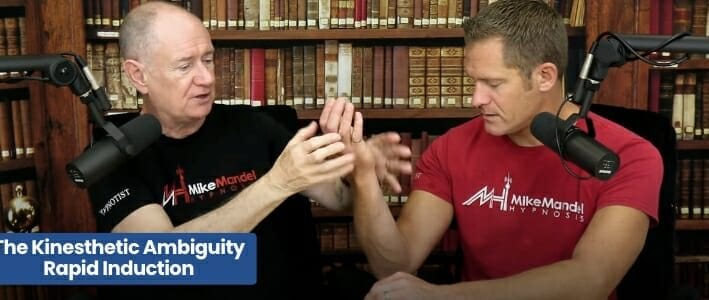
The Kinesthetic Ambiguity Rapid Induction
There are three basic modalities we used to understand the world. To represent them, we use the acronym VAK. Visual, Auditory and Kinesthetic.
The kinesthetic modality relates to physical sensations and emotions. But for this induction, we’re only going to use the sense of physical touch.
The Kinesthetic Ambiguity induction consists of touching the subject’s hand in an ambiguous way such that they can’t figure out exactly what you intend to have happen. This results in spontaneous catalepsy.
It’s spontaneous because we don’t pre-frame that the arm will become cataleptic. We only draw attention to it after we’ve already achieved the phenomenon.
Setting Up the Catalepsy
After getting agreement via a yes set, ask to borrow “that hand” as Mike demonstrates. That request does two things at once: it gets compliance, and it dissociates them from their own arm.
Now hold the hand lightly in front of them, as if you were shaking hands in close. Only your fingers touch their hand. Zero palm contact. That detail is the whole induction. With no palm underneath, they are supporting the weight of their own arm and they have no idea they are doing it. Then ask them to close their eyes.
With the subject’s eyes closed and his hand hovering in front of him, you do a few light touches on different parts of his hand and wrist. At this point, the brain has received a series of unconscious messages that culminate in a spontaneous cataleptic hand and arm.
As a bonus, we can use the catalepsy to practice Ericksonian pacing and leading, as we explain in this blog post and Mike demonstrates in the video. These pacing suggestions draw attention to the cataleptic limb and use it to segué into a hypnotic trance.
To finish the induction, just say “that’s right…”
Doing It Online: The Pen Induction
You cannot borrow someone’s hand over Zoom, but you can borrow their attention, and that is all the induction actually needs.
Ask them to hold a pen lightly between finger and thumb and look at it. Have them notice its weight, its temperature, the exact point where their fingers meet it. Then ask them to close their eyes and keep holding it. After a few moments, ask them to let the pen go, and keep their hand exactly where it is.
The hand stays. The pen is gone and the holding remains, which is catalepsy without a single touch. From there you pace and lead off the hand exactly as you would in person.
The Walter B. Gibson Induction
This induction employs the classical method of inducing trance through eye fixation. Walter Gibson (or whoever he learned this induction from) figured out you can use this method with built-in fractionation as well, which is what his induction consists of.
Mike found this induction in an old book: “The Key To Hypnotism”, by Walter B. Gibson. That’s why we named the induction after him. This was also the first induction Mike ever learned at the age of 12. It’s the reason Mike got hooked on hypnosis!
As with any induction of this kind, you ask the subject to stare at something slightly above eye level. This will cause his eyes to eventually feel heavy and fatigued. In the context of a hypnotic induction, the psychological response caused by eye fatigue rapidly results in a hypnotic trance.
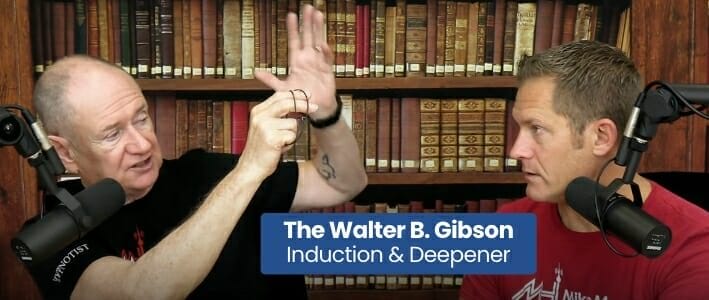
Instead of having the subject simply stare at something, this induction will require him to repeatedly open and close his eyes. This will not only increase eye fatigue, but create a more powerful trance through the principle of fractionation.
Fractionation is well known because of the work of one of the hypnosis greats, Dave Elman. Fractionation is designed right into the famous Dave Elman Induction, too. It is a powerful technique to deepen trance, but it’s also built into the Walter B. Gibson induction.
To understand what fractionation is and how it’s used in hypnosis, click here.
Avoid using language that’s too direct and paternal. Instead, pace the subject’s experience and adopt a more maternal approach by telling him to “permit” or “allow” his eyes to close. To learn the difference between the paternal and maternal approaches in hypnosis, click here.
The induction ends by suggesting that, at some point, the subject’s eyes will be so tired they just won’t open again. When you notice it’s becoming really difficult for him to open his eyes, just say “eyes closed now…”

Learn Hypnosis Online
With the Mike Mandel Hypnosis Academy.
World Class Training—Hypnotize Anyone.
Breathing With the Hand Induction
Mike learned this from his own mentor, the late great Darek Balmer.
It starts in the same way as the Kinesthetic Ambiguity induction: by asking to “borrow that hand” from the subject and saying “eyes closed now”.
The difference with this induction is you won’t position the hand in front of the subject’s eyes. You’ll hold it up by the wrist instead, letting it rest on your finger as in the image below.
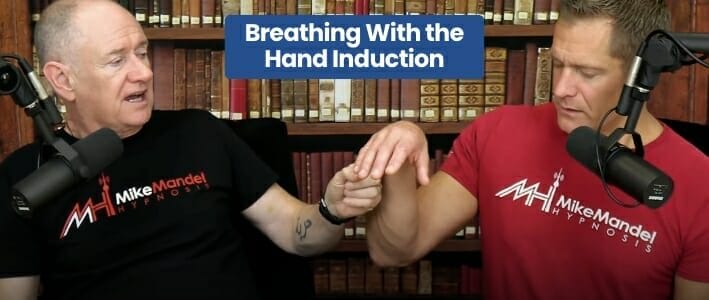
The next step is to instruct the subject to take a deep breath, and slightly lift his hand as he does, accompanying the movement of his breath. Then you tell him to exhale, and let his hand drop slightly as well.
Suggest to the subject that he’ll fall deeper into trance with every motion. Eventually, you may remove your finger from under his hand, drawing his attention to it as the movement becomes automated, and suggesting the hand is getting heavier and sinking down as he sinks deeper into trance.
“That’s right…”
What to Do When It Doesn’t Look Like It’s Working
This is where most people learning hypnosis come unstuck. You run the induction, you look at the person, and nothing obvious happens. So you stop, you apologize, or you start again.
Don’t.
Mike has been teaching this for a long time, and it really is that simple: go in with the attitude that you can handle anything. Be congruent. Be confident. Act with intention. That is the Mandel Triangle in action, and it does more work in a first induction than any technique on this page.
Never act surprised, whatever they do. Your reaction is what sets theirs. Act like something went wrong and they will react like something went wrong. Act like this is completely normal and they will take their cue from you.
Don’t go back and redo the induction because you think it did not work. Nothing tells a person that hypnosis failed faster than the hypnotist starting over.
If they open their eyes, use it. Do not tell them they were not supposed to. Treat it as the perfect thing to have happened: “and as your eyes are open now, you can find a spot on the wall and let your gaze rest there.” You have just hypnotized an already hypnotized person and picked up a deepener on the way. That is utilization doing the work for you.
Know what you are actually looking for. Trance shows up in small things, not dramatic ones: changes in breathing, slackening facial muscles, swallowing, stillness, a shift in posture, movement under the eyelids, a change in skin tone. Learn these and you stop waiting for a sign that was there all along.
One more thing, and it comes before the induction rather than during it. Ladder compliance from the start, with a yes set and a few easy requests, and they are very unlikely to open their eyes and tell you this is not working. Most of what goes wrong during hypnosis is an expectation problem that could have been prevented beforehand.
Free Power Inductions Tutorial
This free video tutorial shows you exactly how to perform Rapid and Instant inductions. This is one of our most popular video tutorials of all time!
3 Easy Hypnotic Deepeners You Can Use Right Now
Except for the Dave Elman induction, which already has an embedded deepener, it’s good practice to always use a deepener after a successful induction.
At least until you’re good enough at calibration to know exactly how deep into trance your subjects are, do one of the following deepeners after each and every induction.
The Shoulder Press Deepener
This is the only deepener on this list which requires you to be physically present. The rest can be easily done while in a video call.
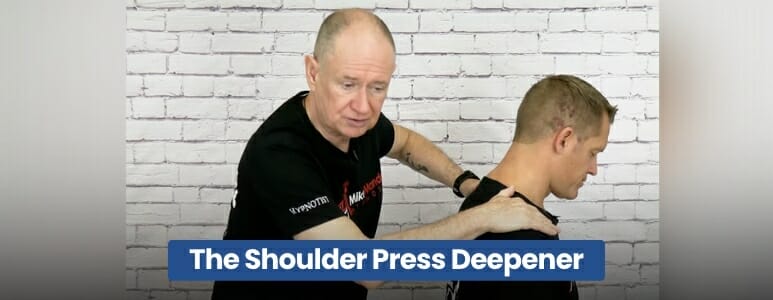
With the subject sitting down after an induction, pre-frame that, in a moment, you’ll put your hands on his shoulders and ask him to take a deep breath, and that as he exhales, you’ll press his shoulders, sending him into a deeper trance.
Press the subject’s shoulders down gently, and watch as the trance deepens and stabilizes.
Deepen Using Fractionation
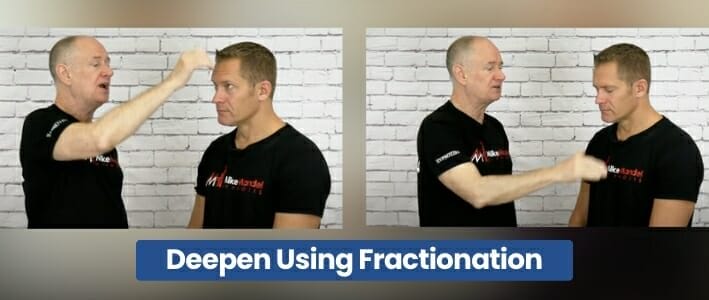
We talked about fractionation earlier in this blog post. By bringing the person to the surface of their trance and immediately putting them back in, the trance will deepen. That’s fractionation in a nutshell.
Just do it exactly how you’d do it in the Dave Elman induction. Ask the subject to open his eyes and look at your hand as it passes in front of him, then close them again. Suggest him going twice as deep each time. You can do this five or six times for maximum effect.
That’s it. It’s that simple
Deepen by Utilizing Catalepsy
We’re using catalepsy as a deepener this time. Actually, we’re pointing out how important it is to use it to deepen trance after an induction like Kinesthetic Ambiguity, which you just learned.
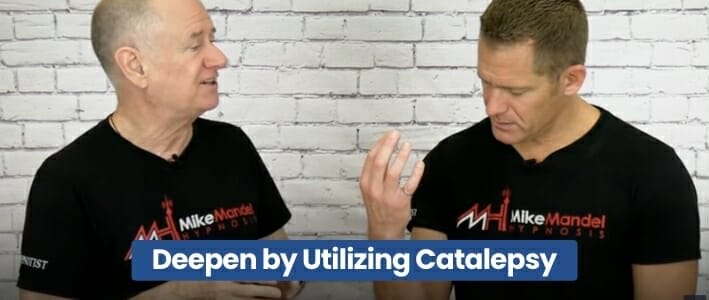
To complement the already powerful use of catalepsy to deepen trance as the hand sinks, observe Mike’s maternal use of language as he paces Chris’ experience and leads it towards a deeper hypnotic trance.
Bonus Deepener: “And your unconscious mind knows…”
This bonus deepener might just be the best one ever. It’s so good we wrote a separate blog post about it.
Frequently Asked Questions
Are these instant or shock inductions?
No. These are rapid inductions, which is a different thing. A rapid induction builds a response over a few seconds using compliance and ambiguity. An instant or shock induction drops someone in one movement, usually with a sudden interruption of balance or attention. Rapid inductions are where to start, because they are forgiving: if the response is slow you simply keep going. We teach shock and instant inductions too, but not first.
What if I learn this and still cannot hypnotize anyone?
Then you have most likely been waiting to see trance before behaving as though hypnosis has begun. That is the single most common reason a technically correct induction goes nowhere, and it is an attitude problem rather than a technique problem. Read the section above on what to do when it does not look like it is working.
Do I need a script for these?
No, and a script will get in your way. Each of these inductions is a short sequence of actions and a few sentences of pacing and leading. Once you can generate hypnotic language in real time you will never want a script again.
Can I use these on myself?
Not these three, they need a second person. Self-hypnosis works differently and we cover it separately.
Want the full picture? Our ultimate guide to hypnotic inductions maps every family of induction, and the Dave Elman induction is the direct-model classic to learn next. When you are ready to work with real people, start with the client interview.
Ready to Master Hypnosis?
If you're serious about truly mastering hypnosis, you've just found the right place.
At the Mike Mandel Hypnosis Academy, we don’t rely on scripts. You'll learn the core principles that make hypnosis truly work—so you can adapt, improvise, and create lasting change with real confidence.
Whether you’re brand new to hypnosis or already a seasoned practitioner, you’ll gain the tools and deep understanding you need to take your hypnotic skills to the next level.
As a member, you’ll also unlock 24/7 access to our exclusive online practice rooms—a place where hypnotists from around the world meet to practice, experiment, and grow together in a supportive, feedback-rich environment.
Click here to join the Mike Mandel Hypnosis Academy today—and experience the difference between reading scripts and becoming a true hypnotist. Just $1 to get started.