
All language is hypnotic…Even this sentence…
We humans are an unusual species in many ways.
Crows can use tools. Dolphins can communicate. Gorillas can learn signs. But none of them come close to what humans do with language. We don’t just signal danger or food or mood. We create meaning. We tell stories. We shape reality with sound.
And nowhere is that more evident than in the English language, which, according to linguists, contains one of the largest and most nuanced vocabularies ever assembled. We have words for subtle emotional states, moral distinctions, abstract concepts, and imagined futures. We can describe something that has never happened and feel it as if it has.
That alone should tell you something important.
When we speak, whether it is a Shakespearean soliloquy or a muttered insult under our breath, something remarkable happens inside the listener. A cascade of neurological events begins instantly, far faster than conscious thought.
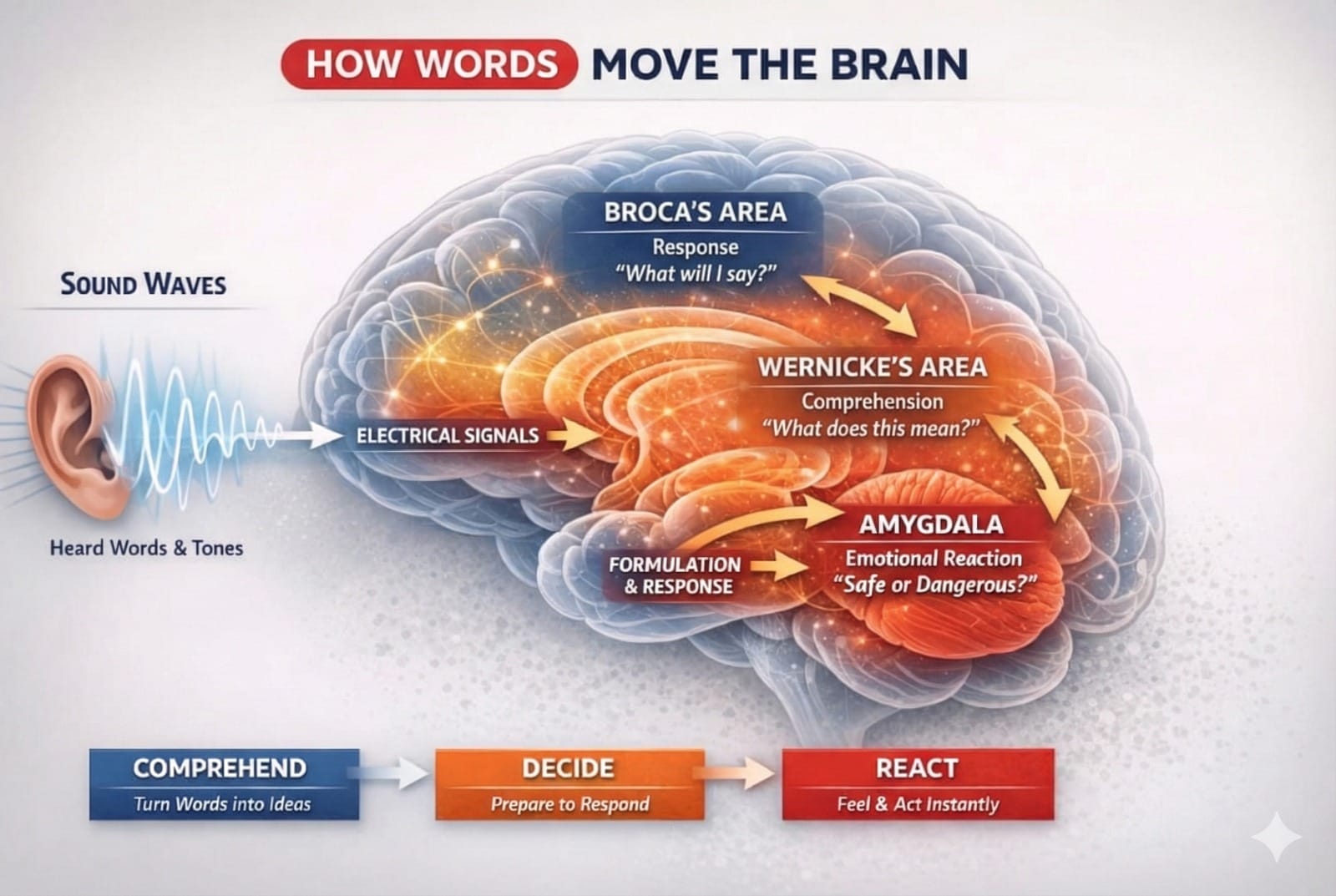
Sound waves enter the ear and are converted into electrical signals. Those signals are routed to specific regions of the brain that exist for one purpose only, to make meaning out of sound.
The first major stop is Wernicke’s area. This region of the brain handles comprehension. It does not judge or analyze. It simply asks, “What does this mean?” Words become ideas here. Tone becomes intent. This is where language turns into internal experience.
From there, information travels to Broca’s area, which handles formulation and response. This is the part of the brain that decides what you will say next, how you will say it, and even whether you will speak at all. It also plays a role in your inner voice, that constant quiet narration that accompanies your thoughts throughout the day.
But here is where things get truly interesting.
Neither of these regions works alone.
They are tightly linked to the limbic system, especially the amygdala. And the amygdala does not care about logic or accuracy. It cares about emotional relevance and survival.
The amygdala asks one question only.
Is this safe or dangerous?
When words carry emotional weight, when they imply threat, belonging, rejection, love, shame, or approval, the amygdala activates instantly. Heart rate changes. Breathing shifts. Muscles tighten or relax. Hormones are released. The body prepares to act.
This happens before conscious thought.
Which means that language does not merely communicate ideas. It triggers physical and emotional states.
That is hypnosis.
Not the stage version with subjects riding imaginary roller coasters or swatting non-existent mosquitoes, but genuine day to day experience, consisting of focused attention. Heightened responsiveness. A shift in internal state driven by meaning.
A single sentence can make someone feel calm or furious. Safe or exposed. Confident or small. Hopeful or defeated.
And here is the part most people never realize.
The brain does not distinguish very well between words spoken by others and words spoken internally. The same neural circuits fire when you hear a sentence and when you say it silently to yourself.
Your inner dialogue is running hypnosis all day long.
Every “I can’t” reinforces limitations.
Every “I always mess this up” strengthens a pattern.
Every “this is dangerous” primes fear.
Every “I’ve got this” builds stability and confidence.
The brain believes the story it hears most often.
This is why words can heal or harm. Why encouragement changes performance. Why criticism lingers. Why certain phrases from childhood echo for decades. Why a single conversation can change the course of a life.
Language directs attention.
Attention shapes perception.
Perception drives emotion.
Emotion drives behavior.
Once you see this, you start to notice it everywhere.
In advertising.
In politics.
In therapy.
In relationships.
In prayer.
In storytelling.
In the way you talk to yourself at three in the morning.
The people who understand this consciously have an extraordinary advantage. They know how to choose words that calm rather than inflame. They know how to guide attention instead of fighting resistance. They know how to speak in ways that bypass defensiveness and go straight to experience.
They know how hypnosis actually works.
And no, it is not about control. It is about precision. About understanding how the human mind naturally processes language and emotion, and working with that process instead of against it.
Once you learn how language truly functions in the brain, you can never hear words the same way again. You start to notice patterns. You hear suggestion embedded in ordinary speech. You become aware of how easily states shift with the right phrasing.
Most importantly, you gain the ability to use language deliberately, ethically, and powerfully.
With others.
And with yourself.
That is what real hypnosis training is about. Not tricks. Not scripts. Not theatrics
It is about understanding how words move the mind, how attention shapes experience, and how subtle changes in language can create profound shifts in perception and behavior.
Once you see it, you cannot unsee it.
And once you understand it, you will realize that you have been surrounded by hypnosis your entire life.
The only question is whether you are using it consciously or letting it use you.
- Mike Mandel
Unlock the Full Potential of Your Mind
If staying focused, communicating better, learning faster, and mastering your mind sounds appealing, the Brain Software Syndicate is the perfect next step. It’s packed with powerful tools and strategies for state management, personal transformation, and much more.
Whether the goal is to sharpen focus, eliminate mental roadblocks, or simply become more effective in daily life, Brain Software Syndicate provides the techniques to make it happen. Plus, it’s an interactive community of like-minded people who are all committed to personal growth and peak performance.
Join Brain Software Syndicate today and start using these tools to unlock your full potential.