

How can something so simple be so incredibly powerful?
Let’s talk about a rather fascinating concept that comes from NLP and has proven its worth over and over again.
It’s known as the As If frame, sometimes called the Power of Pretending.
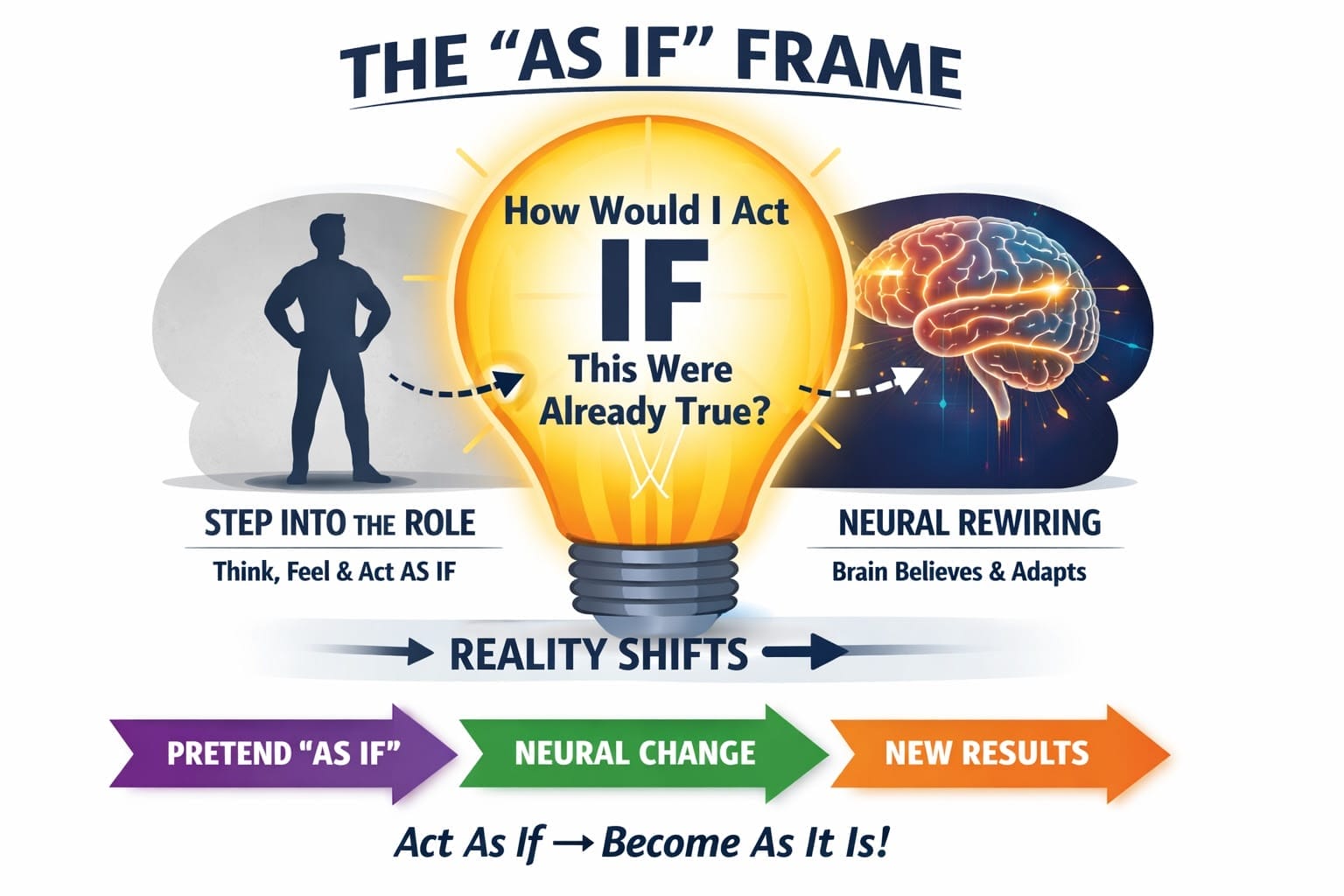
The core idea is deceptively simple. You first decide what identity, quality, or behavior you want to experience. Then you ask yourself one empowering question:
“How would I act if this were already true in my life?”
Once you answer that, you simply begin acting that way now. No waiting, no hoping. Just begin. And when you do, your neurology quietly takes over and starts filling in the gaps.
As strange and counterintuitive as this sounds, it rapidly rewires the brain just as surely as if the pretense were reality. From the perspective of your nervous system, what you consistently rehearse becomes what you actually live.
This principle is well known in the film industry, where acting roles have an uncanny tendency to blur into reality. When co-stars repeatedly play the part of being in love, they behave as though it is true. Their brains respond accordingly, releasing bonding chemicals like oxytocin. Over time, the illusion becomes self-sustaining and life begins to imitate the role.
Just ask Julia Roberts, who has famously fallen for several of her leading men. On screen, she was pretending to be in love, but the performance was so vivid, so emotionally real, that her brain believed it. The chemistry followed and the story wrote itself.
Scientifically, this makes complete sense. It’s long been established that the unconscious mind does not reliably distinguish between a real experience and one that is vividly imagined. Whether something is happening in the outside world or being internally rehearsed with rich sensory detail, your deeper mind treats it as real. It records it the same way, responds to it the same way, and often begins adjusting your behavior accordingly.
And this is where the idea becomes even more interesting and practical.
Neurologically, activating a desired state such as confidence, clarity, or motivation lights up the same neuronal circuits as actually being in that state. The key is intention and full participation. You must show up for the role, mentally and physically. The more completely you step into the experience, the more profound the changes become.
This kind of pretending is not superficial. Done well, it builds cognitive and emotional congruence before any external results show up. And in many cases, the outer shift is simply your life catching up with what you’ve already become internally.
But don’t just take my word for it. There's a striking study that illustrates this concept with almost eerie clarity.
In the late 1970s, Harvard psychologist Ellen Langer conducted what became known as the Counterclockwise Study. She gathered a group of men in their seventies and placed them in a retreat that was meticulously designed to reflect the world of twenty years earlier, when they were more youthful.
The magazines, music, television shows, and even the discussions were all centered around the past. There were no mirrors. No cues about their current age or health status. The men were asked to behave, speak, and think as if it were truly that earlier time.
And what happened next was remarkable.
After only one week, measurable physical and cognitive changes were observed. The men showed improvements in posture, joint flexibility, memory, hearing, and grip strength. Even more astonishing, independent observers who looked at before-and-after photographs consistently rated the men as looking younger at the end of the study.
Nothing external had changed. No surgeries. No new treatments. What changed was their frame of reference, the identity they were living from. They stopped acting like old men. And their bodies, minds, and behaviors began to follow suit.
Of course, the opposite is also true.
If you consistently act as though a negative state is real, that too will find its way into your life. People who enter environments associated with decline, like aged-care homes, often begin shuffling, speaking more slowly, and losing cognitive sharpness. And yet, those who continue to act younger, who play, engage, and challenge themselves, tend to maintain vitality far beyond what is expected.
So ask yourself some useful questions.
Do you want confidence? Ask, how would I stand, breathe, and speak if I already had unshakable confidence?
Want to be a writer? Ask, what would I do today if I were already a successful writer?
Want to be healthy, joyful, grounded, magnetic? Pick your quality. Step into it now, not someday. Now.
You may have heard the phrase, fake it until you make it.
Personally, I prefer this version:
Fake it until you become it.
Because once your unconscious accepts the role you are rehearsing, the rest has a way of taking care of itself.
And if you're going to pretend... pretend powerfully.
- Mike Mandel
Ready to Master Hypnosis?
If you're serious about truly mastering hypnosis, you've just found the right place.
At the Mike Mandel Hypnosis Academy, we don’t rely on scripts. You'll learn the core principles that make hypnosis truly work—so you can adapt, improvise, and create lasting change with real confidence.
Whether you’re brand new to hypnosis or already a seasoned practitioner, you’ll gain the tools and deep understanding you need to take your hypnotic skills to the next level.
As a member, you’ll also unlock 24/7 access to our exclusive online practice rooms—a place where hypnotists from around the world meet to practice, experiment, and grow together in a supportive, feedback-rich environment.
Click here to join the Mike Mandel Hypnosis Academy today—and experience the difference between reading scripts and becoming a true hypnotist. Just $1 to get started.