

Why do we procrastinate, when it usually causes more problems than it solves?Enter your text here...
Almost everyone does it. Even people who are disciplined in most areas of life suddenly find themselves avoiding a phone call, delaying an email, postponing paperwork, or ignoring some small task that would take ten minutes.
And when people talk about procrastination, they usually say the same thing.
"I'm just being lazy."
But that explanation is almost always wrong.
Procrastination is really about pain avoidance. Your brain takes a quick mental preview of the task and attaches a bit of emotional discomfort to it. Maybe it looks tedious. Maybe awkward. Maybe boring. Maybe uncertain. Sometimes it is just vaguely unpleasant.
So the mind quietly says something very simple.
Not now…
And for a moment that feels good. The relief is immediate.
But here is the catch.
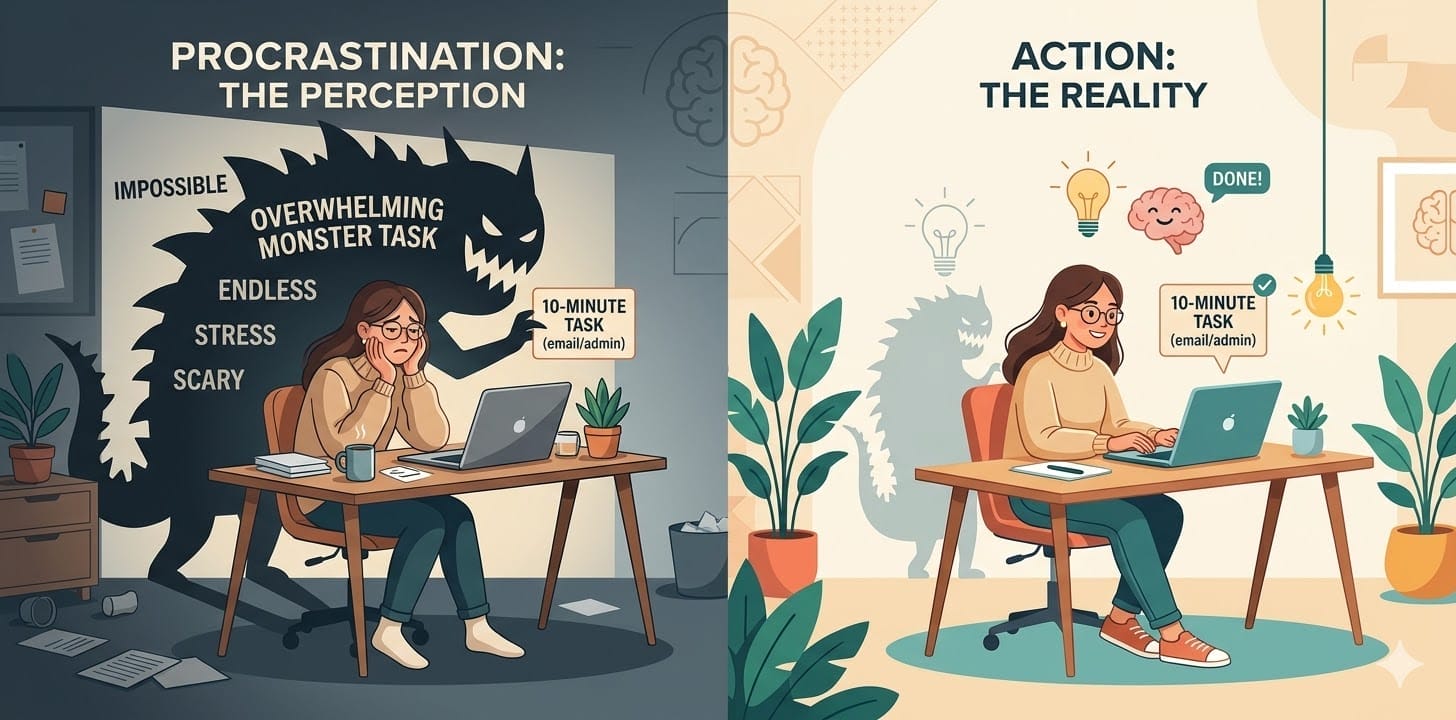
The task does not disappear. Instead it sits quietly in the background of your mind. And every time you remember it, the anxiety grows slightly larger. What started as a small discomfort becomes heavier and heavier the longer it sits there.
Many people notice something interesting here. The task itself has not actually changed. It is the anticipation of it that keeps growing.
People often hope things will magically resolve themselves if they wait long enough.
Sometimes they do.
Most of the time they don't.
So the pressure slowly builds in the background. A task that might take ten minutes begins to feel like a looming event simply because we have given it time to expand in our imagination.
This is why one of the most useful habits you can develop is something I call front-end loading.
Do the unpleasant thing first.
Handle the difficult conversation early. Send the awkward email. Make the call you have been avoiding. Fill out the form that has been sitting on your desk all week.
Once it is done, something interesting happens. The anxiety vanishes almost instantly. Your mind relaxes and the rest of the day becomes lighter. Many people notice they suddenly feel more energetic simply because the background tension is gone.
There is another trick that works beautifully.
Make a five minute commitment.
Tell yourself you will work on the task for five minutes. After that, you are completely free to stop.
Five minutes feels manageable. Anyone can do five minutes.
What usually happens is something quite interesting. Once you start, momentum kicks in and you keep going. Ten minutes pass. Fifteen minutes pass. Often the task gets finished simply because you began.
Starting breaks the spell.
Years ago in my practice I sometimes used a slightly mischievous method with chronic procrastinators.
I told them not to stop procrastinating.
Instead I asked them to put off procrastinating until later.
If they felt the urge to avoid the task, that was fine. They were allowed to procrastinate. They just had to postpone the procrastination for fifteen minutes.
In other words, they could procrastinate later, but right now they had to begin.
People usually laughed when they heard that.
But it worked surprisingly well, because procrastination is already a skill they possess. We simply redirect the skill toward something useful. Instead of postponing the task, they postpone the avoidance.
And that small shift often breaks the pattern.
This is also where hypnosis becomes very interesting.
When people procrastinate, they are actually responding to an internal suggestion. The mind says something like, "This will be unpleasant," or "I don't feel like doing this right now." The brain accepts that suggestion and follows it automatically.
In other words, the person has hypnotized themselves into delay.
Hypnosis teaches us something important about how the mind works.
The brain responds very strongly to imagery and suggestion.
When someone procrastinates, they often picture the task as large, looming, and unpleasant. The mental movie exaggerates the discomfort. The job looks bigger in the mind than it really is.
So we can change the movie.
Shrink the image of the task in your mind. Push it farther away. Make it smaller and less dramatic. Sometimes I tell people to imagine it as a small task card sitting on a desk rather than a giant looming wall.
Then do the opposite with the reward.
Imagine the feeling of relief once the task is finished. Picture yourself leaning back, relaxed and satisfied, knowing it is done. Feel the sense of completion and the lightness that follows.
This is a very simple hypnotic principle.
Change the internal picture and you change the emotional response.
And when the emotional response changes, behavior often follows very naturally.
The brain is rarely resisting the task itself. It is resisting the feeling it expects to have while doing the task.
Change the feeling and the action becomes easier.
So here is a small experiment for today.
Pick one thing you have been putting off.
Just one.
Set a timer for five minutes and begin. If you feel the urge to procrastinate, simply put-off the procrastination until later.
You may be surprised how quickly things begin to move.
- Mike Mandel
Unlock the Full Potential of Your Mind
If staying focused, communicating better, learning faster, and mastering your mind sounds appealing, the Brain Software Syndicate is the perfect next step. It’s packed with powerful tools and strategies for state management, personal transformation, and much more.
Whether the goal is to sharpen focus, eliminate mental roadblocks, or simply become more effective in daily life, Brain Software Syndicate provides the techniques to make it happen. Plus, it’s an interactive community of like-minded people who are all committed to personal growth and peak performance.
Join Brain Software Syndicate today and start using these tools to unlock your full potential.