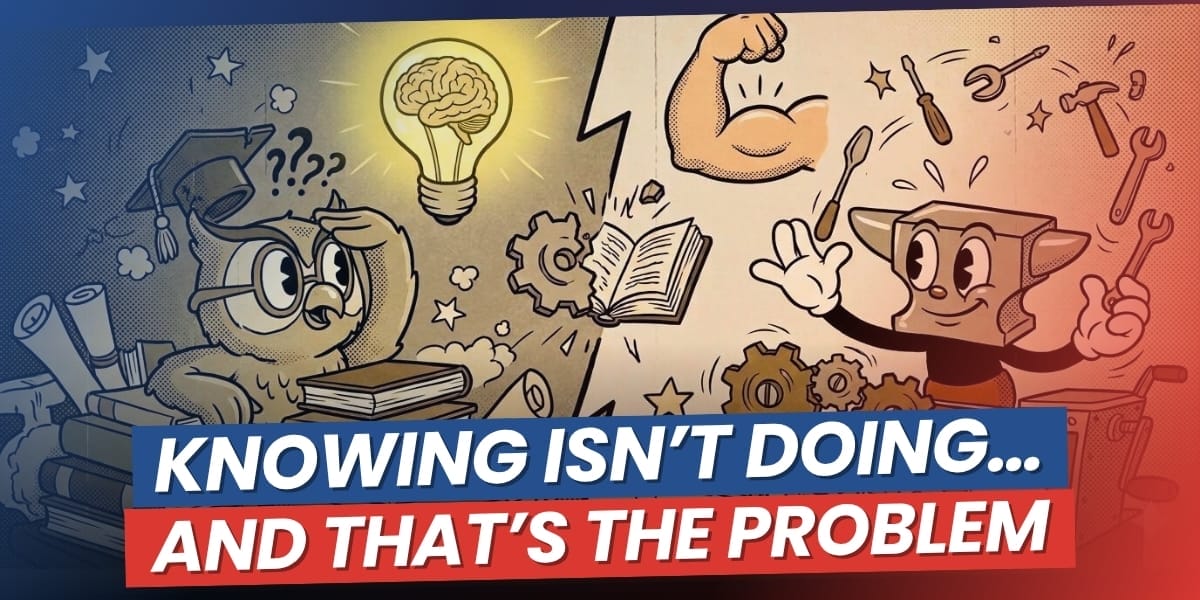
Skills are different from knowledge…
And that difference is one of the most quietly dangerous blind spots I see in people all the time, especially in those who consider themselves intelligent, well-read, and highly informed.
We humans have an extraordinary capacity to gather knowledge. We read constantly. We listen to podcasts while driving. We watch tutorials late into the night. We fill our minds with concepts, frameworks, distinctions, and ideas, and we take a certain comfort in the feeling that comes with understanding something intellectually. It gives us the sense that we are progressing, that we are improving, that we are somehow getting closer to mastery. But understanding is not the same as being able to perform an actual skill.
There is a very real and often painful gap between knowing what to do and actually being able to do it when it matters, when the pressure is on, when there is no time to sit back and analyze the situation. A person can read extensively about CPR, understand the sequence perfectly, and still find themselves frozen when confronted with a real emergency. Another person can study communication models, memorize patterns of language, and still fail completely when a conversation becomes emotionally charged, messy, and unpredictable.
In the same way, someone can spend hours watching videos about growing food, defending themselves, or handling crisis situations, and yet be completely ineffective the moment they are required to act in the real world, where variables change and nothing unfolds exactly as expected. Knowledge is stored in the mind as information, neat, organized, and often impressive when discussed, but skill is installed through repetition, through experience, and through engaging the body and nervous system until the behavior becomes automatic and reliable.
When I trained 50 Ontario Provincial Police hand-to-hand combat instructors, I knew I had a real skill set that I could apply without thinking about it. It was more than head-knowledge, because it worked in the real world, and under stress conditions.
This is where hypnosis enters the picture in a very real and very practical way. Hypnosis, at its core, is not about information. It is about installation. It is about taking something that is currently a concept, and turning it into a response, something that happens without hesitation, without internal debate, and without the need to stop and think your way through it step by step.
And this is exactly where many people who study hypnosis begin to struggle, often without realizing why. They attend trainings, they read books and collect scripts, they understand the models, and they can even explain the concepts quite well, but when they sit down in front of a real person, something doesn’t translate.
The timing is off, the confidence is not quite there, and the responses they expect simply do not occur. It is not a lack of intelligence or even a lack of knowledge, it is the absence of properly installed skills, developed through guided practice, immediate feedback, and real-world application where adjustments can be made in the moment.
When we train properly, whether it’s first aid, communication, cooking, or even something as simple as maintaining composure under stress, we are not trying to know more. We are conditioning ourselves to respond differently. We are teaching the unconscious mind to take over at the exact moment when conscious thought would slow us down or fail us entirely. This is why practice matters so much more than passive consumption, and why so many people who consume endlessly still feel stuck.
Every time you rehearse a skill, especially when you do it with focus, intention, and emotional engagement, you are laying down neurological pathways that become easier to access under pressure. When you combine that with hypnotic techniques such as visualization, mental rehearsal, and deliberate state control, you accelerate that process in a profound way and begin to close the gap between knowing and doing. You are no longer just learning in the intellectual sense, you are installing patterns of behavior that will execute when needed, even when your conscious mind is overwhelmed or distracted.
And once something is truly installed, it becomes part of you in a very real sense. You do not need to remember it or think about it, it simply shows up, cleanly and efficiently, when it is needed most. That is the difference between someone who knows about something and someone who can actually do it, consistently, reliably, and under pressure.
So here is something worth considering as you move through your week. Where in your life are you collecting knowledge instead of building skill, and what are you learning that you have never actually practiced, never tested, never installed at the level where it becomes automatic?
More importantly, what would change for you if you shifted your focus away from gathering more information and toward installing real, usable abilities that you can rely on when it truly counts? Because in the end, it is not what you know that makes the difference, it is what you can do, automatically, effectively, and without hesitation, when it matters most.
- Mike Mandel

Unlock the Full Potential of Your Mind
If staying focused, communicating better, learning faster, and mastering your mind sounds appealing, the Brain Software Syndicate is the perfect next step. It’s packed with powerful tools and strategies for state management, personal transformation, and much more.
Whether the goal is to sharpen focus, eliminate mental roadblocks, or simply become more effective in daily life, Brain Software Syndicate provides the techniques to make it happen. Plus, it’s an interactive community of like-minded people who are all committed to personal growth and peak performance.
Join Brain Software Syndicate today and start using these tools to unlock your full potential.